 StarHop NavigatorDE
What affects accuracy, what to expect, and how to get the best results.
That's the real question. StarHop Navigator guides your telescope to the target — but due to sensor limits and calibration quality, there's always a small offset. Whether the target lands inside your eyepiece view depends on two things:
Good calibration (3+ stars, stable mount): the target is within about 0.7° of center. Poor calibration (1 star, shaky mount): up to 1.5° offset.
A wider true field of view means more sky visible through the eyepiece — more room for the target to land inside the view, even with some offset.
If the error circle fits inside the eyepiece circle — you'll see the target. If not — sweep slowly around the area.
A classic Dobsonian with 1200mm focal length. High magnification, narrow fields of view.
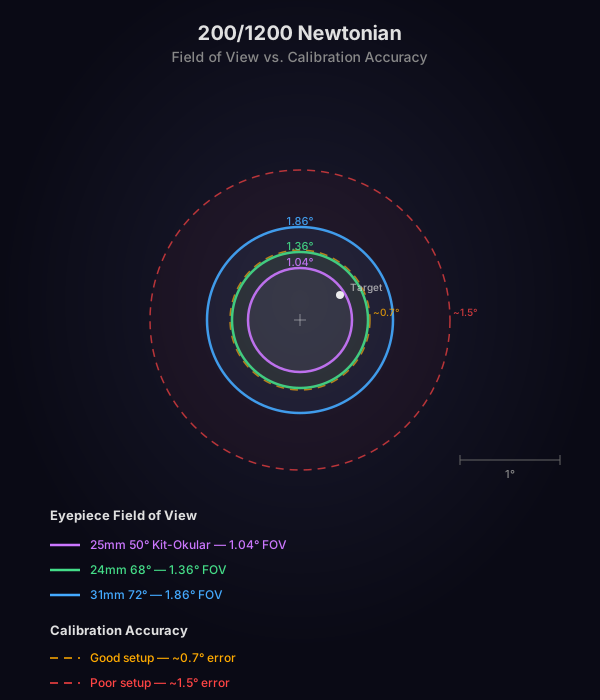
| Eyepiece | Magnification | True FOV | Good cal. (~0.7°) | Poor cal. (~1.5°) |
| 25mm 50° | 48x | 1.04° | Tight | Will miss |
| 24mm 68° | 50x | 1.36° | Fits | Borderline |
| 31mm 72° (2") | 38.7x | 1.86° | Comfortable | Fits |
With a long focal length telescope, eyepiece choice matters a lot. A wide-field eyepiece (31mm 72°) gives you enough margin even with imperfect calibration.
A compact tabletop Dobsonian with 650mm focal length. Lower magnification, wider fields of view.
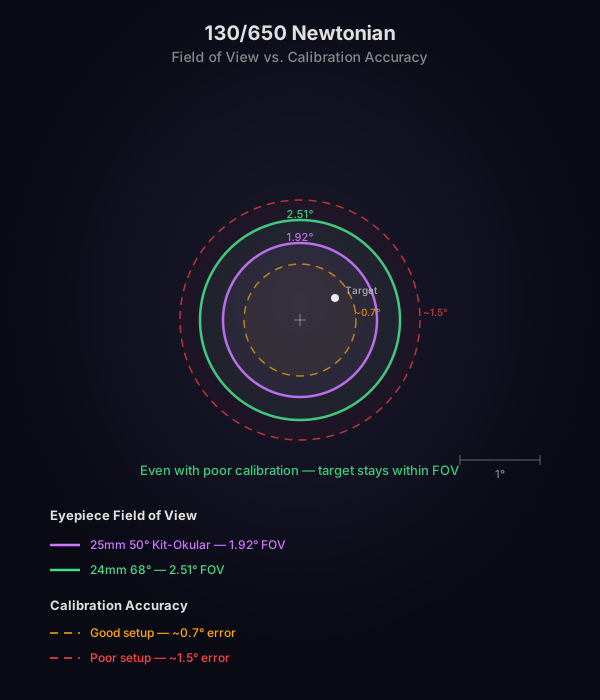
| Eyepiece | Magnification | True FOV | Good cal. (~0.7°) | Poor cal. (~1.5°) |
| 25mm 50° | 26x | 1.92° | Easy | Fits |
| 24mm 68° | 27.1x | 2.51° | Very easy | Comfortable |
The shorter focal length makes finding objects much easier. Even the kit eyepiece with poor calibration keeps the target within the field of view. This is why short focal length Dobsonians pair well with StarHop Navigator.
Same eyepiece, same app, same calibration — but different results. The reason is magnification.
Think of it like a camera zoom: at wide angle, a slightly off-center subject is still in the frame. Zoom in, and the same offset puts the subject outside the frame.
The app's accuracy stays the same — it's the telescope that determines whether that accuracy is enough.
Use your widest field eyepiece (lowest magnification) to find the target. Switch to higher magnification once you've found it.
Two calibration stars give good accuracy. Three is the sweet spot. More rarely helps — the app filters outliers automatically.
A consistent, stable phone mount reduces error more than any software improvement can.
Stars closer to your target region give better local accuracy than stars on the opposite side of the sky.
Check the FAQ or get in touch.